

Green Building & ESG: Navigating Sustainable Real Estate in Dubai
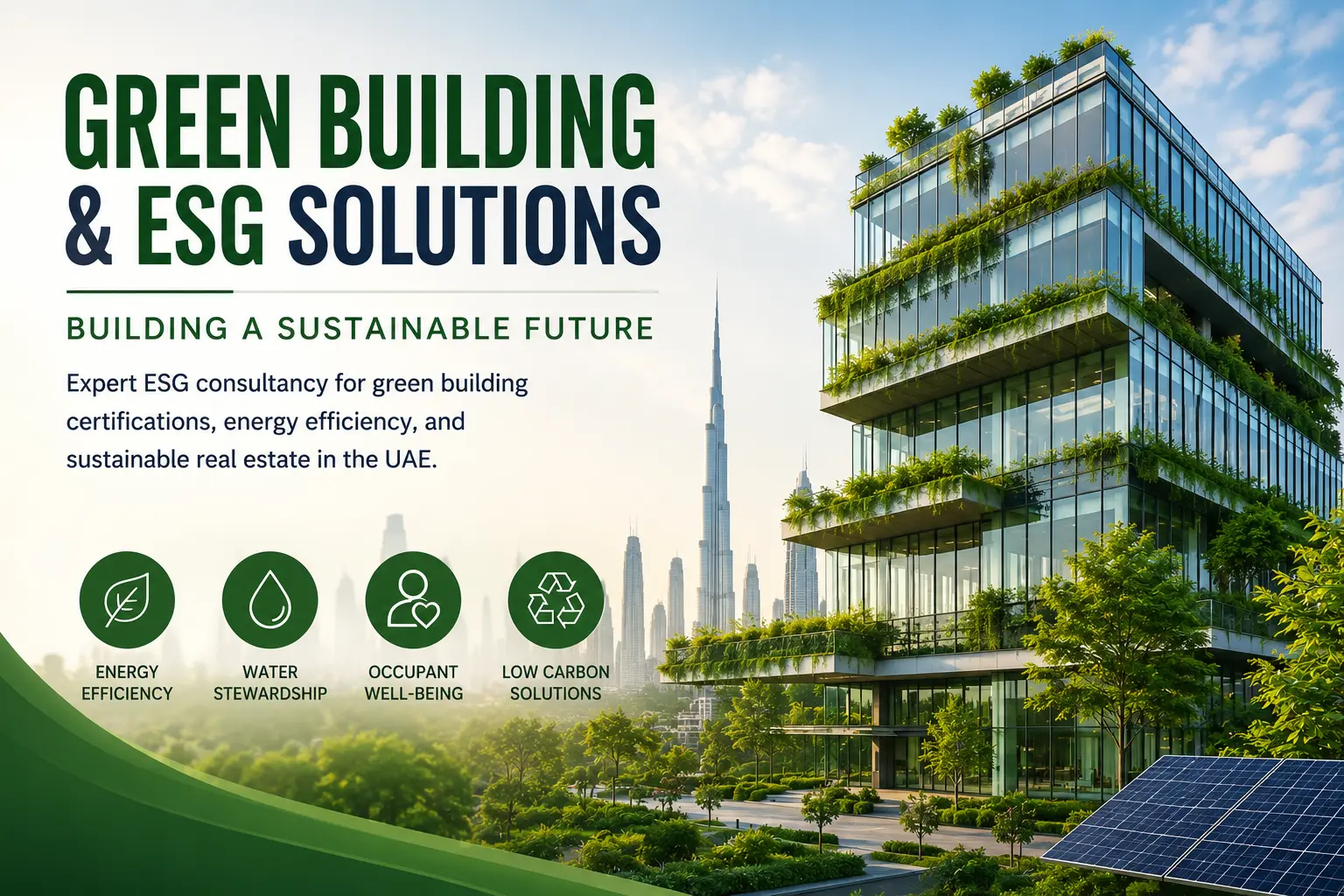
Dubai’s real estate market continues to shatter global benchmarks for growth, luxury, and architectural ambition. Guided by the Dubai Economic Agenda (D33) and the nation's overarching UAE Net Zero 2050 strategic initiative, a secondary boom is quietly taking place: the rise of premium, sustainable property developments.
For asset managers and property developers, implementing a rigid industrial ESG strategy is no longer just an exercise in corporate citizenship. With the sweeping implementation of UAE Federal Law No. 11 of 2024 on Climate Change, building lifecycle emissions, climate risk disclosures, and resource efficiency have become core pillars of financial performance. Embracing sustainable real estate in Dubai is now a critical prerequisite for unlocking institutional capital, mitigating risk, and securing high-value tenants.
The EHS vs. ESG Evolution
For decades, industrial entities in JAFZA, KIZAD, and DIC have relied on traditional EHS frameworks to manage floor-level risks—focusing on waste disposal, localized pollution, and worker safety.
Modern ESG, conversely, looks at enterprise-level risk, corporate governance, and carbon accounting. To avoid fragmented data and regulatory penalties, companies must treat EHS as the operational engine that feeds the ESG reporting framework.
The Green Premium vs. The Brown Discount
In Dubai’s highly competitive commercial and residential landscapes, data reveals a widening yield gap between energy-efficient buildings and legacy properties:
* The Green Premium: Assets with prominent sustainability badges capture higher rental
premiums, lower vacancy rates, and faster lease-up timelines. Multinational corporations
and tier-1 tenants have strict global ESG corporate mandates; they are actively barred
from leasing spaces that do not meet rigorous environmental criteria.
* The Brown Discount: Conversely, properties that ignore modern energy frameworks face
rapid depreciation. High power consumption, reliance on aging HVAC systems, and high
water intensity expose landlords to surging operational overheads and severe
devaluation as regulations tighten.
Crucial Frameworks Driving Green Building Compliance in the UAE
Navigating the local landscape requires understanding both global certifications and regional statutory codes:
1. Dubai Al Sa'fat (Green Building Evaluation System)
Administered by Dubai Municipality, Al Sa'fat is a mandatory system designed to regulate energy, water, materials, and waste across all new building permits. Passing these baseline requirements ensures essential green building compliance in the UAE, guaranteeing a property meets local threshold targets for resource efficiency
2. LEED (Leadership in Energy and Environmental Design)
While Al Sa'fat handles mandatory local permitting, LEED Certification remains the undisputed global gold standard for premium real estate. Attaining LEED Gold or Platinum status elevates an asset's visibility on international investor registries. Working with qualified LEED certification consultants allows developers to smoothly design, construct, and manage high-performance structures that minimize lifecycle operating costs.
3. UAE Federal Law No. 11 of 2024 on Climate Change
This landmark federal decree fundamentally reshapes risk management for real estate developers and asset holders. Large infrastructure and property portfolios must now measure, register, and verify their carbon inventories through the Ministry of Climate Change and Environment (MOCCAE). Failing to disclose precise operational carbon statistics or maintain audit-ready transparency risks heavy administrative penalties.
Turn Your Real Estate Data into Standardized ESG Metrics
A robust property ESG framework translates physical, floor-level building efficiencies into measurable data points valued by banks and global compliance bodies.
| Real Estate Target Area | Operational Improvement | Standardized ESG Metric |
|---|---|---|
| Energy Management | Smart HVAC, LED retrofits, and solar building integration | Reduction in Scope 2 (Indirect) Emissions and lower energy use intensity (EUI) |
| Water Stewardship | Graywater recycling, low-flow fixtures, and smart district cooling | Reduced cubic-meter water intensity, supporting local circular economy guidelines |
| Occupant Well-being | Indoor air quality (IAQ) sensors, biophilic design, and natural daylighting | Social (S) Disclosures directly impacting tenant retention and human health |
| Lifecycle Analysis | Use of low-carbon concrete and locally sourced materials | Decreased Scope 3 (Supply Chain) Embodied Carbon emissions and improved lifecycle sustainability metrics |
Action Plan for Dubai Developers and Property Managers
To ensure your real estate assets remain future-proof, compliant, and highly profitable, prioritize these three steps:
1. Conduct an Advanced ESG Gap Analysis: Evaluate your existing building portfolios
against upcoming UAE climate mandates, regional energy efficiency codes, and global
ESG disclosure indices (such as GRESB and GRI).
2. Prioritize Retrofitting: For existing assets, prioritize immediate energy and water
efficiency updates. Deploying intelligent building management systems (BMS) often
yields an instantaneous drop in utility costs while immediately improving your corporate
ESG score.
3. Engage Specialists Early in Design: Sustainable development is most cost-effective when
addressed during the initial conceptual phase. Partner with experienced advisors to
embed LEED-ready frameworks into your design phase, preventing expensive
adjustments later.
Secure Your Competitive Advantage in Dubai Real Estate
As climate regulations tighten across the GCC, real estate portfolios must transform from passive physical brick-and-mortar structures into active, data-driven ESG assets. Aligning your property pipeline with international green standards insulates your business against regulatory risks while capturing the lucrative green premium.
Is your property portfolio ready for the next wave of UAE compliance mandates?
With over 15 years of boots-on-the-ground experience across Dubai and the wider UAE, ESG Consultants provides comprehensive, end-to-end guidance. From technical LEED certification consulting to building a fully defensible corporate ESG framework, we help you transform real estate risks into measurable financial rewards.
Frequently Asked Questions
Ready to Align Your EHS & ESG Strategy?
Contact Information
Website: https://www.esgconsultants.ae
Email: info@esgconsultants.ae
Phone: +971 52 416 9197